AI-Si.com
GovernanceRegulation

The EU AI Act August 2026 Deadline: What UK Businesses Must Do Now

The EU AI Act August 2026 Deadline: What UK Businesses Must Do Now
Published 13 April 2026Last reviewed 19 April 20264 min readBy Simon Steggles· Fractional AI Director
Who this is for:UK SME owners and directors with any EU customer, employee or supply-chain exposure who need to be ready for 2 August 2026.

TL;DR

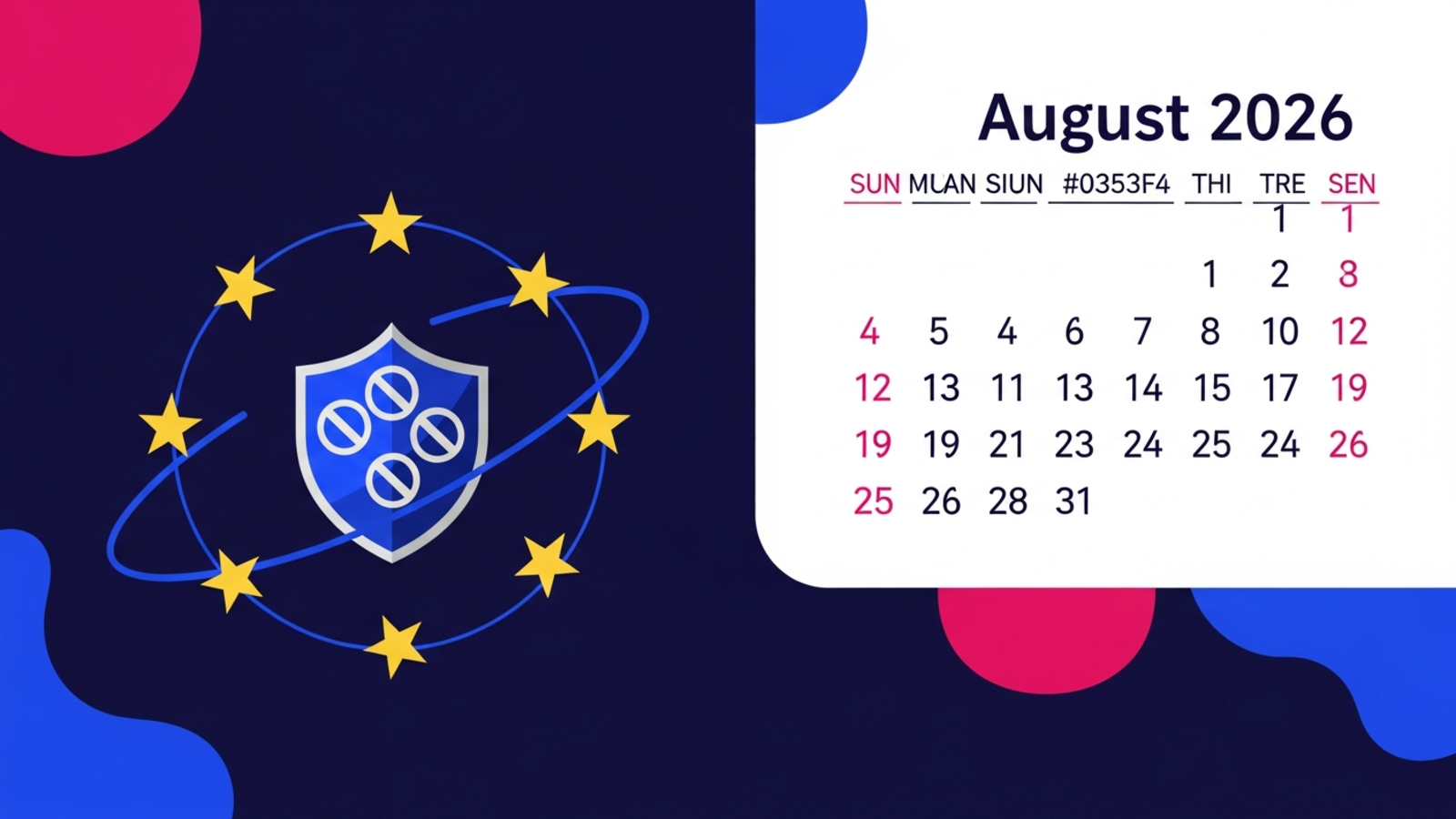
The EU AI Act's full obligations become enforceable on 2 August 2026; UK businesses with EU exposure have sixteen weeks to complete their AI inventory, classify risk, and implement oversight protocols or face fines of up to €35 million.

Key takeaways

  • The EU AI Act applies extraterritorially — selling to or employing EU citizens brings you in scope.
  • Full obligations for high-risk AI become enforceable on 2 August 2026, with fines up to €35m or 7% of global turnover.
  • Embedded AI inside SaaS tools (HR, CRM, recruitment) makes you a deployer with real obligations — not just the vendor.
  • Eight Annex III categories count as high-risk, including recruitment, credit, education and critical infrastructure.
  • Inventory in April, classify in May, document and assign oversight by July — that is the runway you have left.

Sixteen weeks. That is how long UK businesses have before the EU AI Act's full set of obligations becomes enforceable on 2 August 2026. Most organisations that use AI tools, which at this point means almost every business with a CRM, HR platform, or customer-facing chatbot, are not ready. Many do not know whether the regulation applies to them at all. It does.

Yes, It Applies to You

The EU AI Act is not an internal EU matter. Its extraterritorial reach works exactly like GDPR. If your AI system affects people in the European Union, you are in scope. Full stop. It does not matter that you are registered in Birmingham, Edinburgh, or Cardiff. If you sell to EU customers, employ staff in Germany, or use recruitment software that screens EU applicants, the Act applies to your organisation.

The prohibition tier has already been live since February 2025. That covers AI systems that manipulate people without their knowledge, exploit vulnerable groups, or enable real-time biometric surveillance in public spaces. If you were using any of those, you are already in breach. The August 2026 deadline covers the substantive obligations: the full requirements for high-risk AI systems, transparency rules, conformity assessments, technical documentation, and human oversight protocols.

Fines sit at up to €35 million or 7% of global annual turnover, whichever is higher. The GDPR comparison is deliberate. Regulators built this one with teeth from the start.

What Counts as High Risk

The Act designates eight categories of high-risk AI in Annex III. These include AI used in recruitment and employment decisions, systems that affect access to education, tools used in credit scoring and insurance, AI deployed in critical infrastructure, and systems involved in law enforcement. If your business uses AI for any of these purposes, even if the AI is embedded inside a SaaS product you bought rather than built, your obligations are real.

That last point catches a lot of organisations out. If your HR platform uses an algorithm to rank job applicants, that is a high-risk AI system. You do not get to say it is the software vendor's problem. As a deployer, you carry responsibility for how that system operates in your context. You need to be able to demonstrate that you understand what it does, who it affects, and how you oversee it.

The European Commission was supposed to publish guidance by February 2026 to help operators of high-risk systems understand their obligations under Article 6. It missed that deadline. That is not a reason to wait. The legal text already tells you what is required. Waiting for guidance that is already late is not a compliance strategy.

What August 2026 Requires

For organisations with high-risk AI systems, the August 2026 deadline triggers a specific set of requirements. You must complete conformity assessments demonstrating the system meets the Act's standards. You must produce and maintain technical documentation. If relevant, your system needs CE marking and registration in the EU database for high-risk AI. You must implement a risk management system, data governance controls, human oversight mechanisms, and logging capabilities that allow post-market monitoring.

For all AI systems, transparency becomes mandatory at the same date. If your users are interacting with an AI, you must tell them. Synthetic content, including AI-generated text, images, and audio, must carry machine-readable labels. Emotion recognition systems and biometric categorisation tools require explicit disclosure at the point of use.

None of this is optional. None of it is a best-practice recommendation. It is a legal requirement with enforcement consequences.

Where Most UK Businesses Are Right Now

The honest picture is not encouraging. Most organisations with EU exposure fall into one of three positions. The first group has not started. They are aware of the EU AI Act in the same way they are aware of their pension obligations: they know it exists, they intend to deal with it, and they have not. The second group has completed an AI inventory, identified what tools they use, and then stopped. Knowing what you have is the first step. It is not compliance. The third group is actively building frameworks but has not finished.

Four months is not a generous runway for the third group. It is no runway at all for the first two. An AI inventory that covers embedded AI in existing SaaS tools, not just tools procured specifically as AI, can take weeks to complete properly. Risk classification requires legal and technical input. Documentation and oversight protocols take time to design and implement. The clock is not paused while you wait for a convenient quarter to prioritise this.

What to Do Before August

Start with a complete AI inventory. This means every tool in use across your organisation, including the AI features inside Salesforce, Microsoft 365, HubSpot, and any other platform that has quietly added AI capabilities. The inventory must cover both tools you built and tools you bought. Document what each system does, what data it processes, and who it affects.

Once you have the inventory, classify each system against the Act's risk tiers. Most business tools will not qualify as high-risk. But you need to confirm that, not assume it. For anything that touches employment decisions, customer access decisions, or safety-critical processes, get a proper legal assessment.

For high-risk systems, assign ownership. Someone in your organisation must be accountable for each system's compliance posture. That person needs to understand the technical documentation requirements, the human oversight obligations, and the process for logging incidents. If they do not exist yet, find them before the deadline does it for you.

The EU AI Act is not going to wait. Sixteen weeks from now, enforcement begins in earnest. Get the inventory done this month. Classify your systems in May. Have your high-risk documentation and oversight processes operational by July. That is the timeline that gives you a chance of being ready.

About the author

Simon Steggles — Fractional AI Director

Simon helps UK SMEs and councils put AI to work safely. Royal Navy 1984–90 (Cat 3 PV at the time, now superseded by DV); current NPPV3 Police vetting for public-sector work; ISACA AI Governance certified. Based in Birmingham. £300K+ recovered for councils, 43% cost reduction in manufacturing, zero data-protection incidents across every engagement.

More about Simon

Want help applying this?

Grab the free AI Readiness Checklist or book a 30-minute strategy call with Simon — no pitch, no slide deck, just practical advice for your situation.

Free AI Readiness Checklist

Find Out Where AI Can Save or Generate Money in Your Organisation

Book a free 30-minute call with Simon. Bring a real problem — staff time, governance worry, vendor proposal, failing pilot — and leave with a concrete first step you can take next week.

07973 210 895
Call